The flat-as-an-office theory towards nothing
It apparently feels like minus one Celsius outside, on Christmas Day in London, but it got to a balmy twenty-three inside my studio apartment. So, I cracked open the window for a moment for some respite.

I can’t help but marvel at how modern construction methods and insulating materials contain warmth with minimal heating; without their interplay, my plants wouldn’t last beyond a couple days. Their presence softens up a space and their infrequent care is a reminder that an urban brute can be civilised.
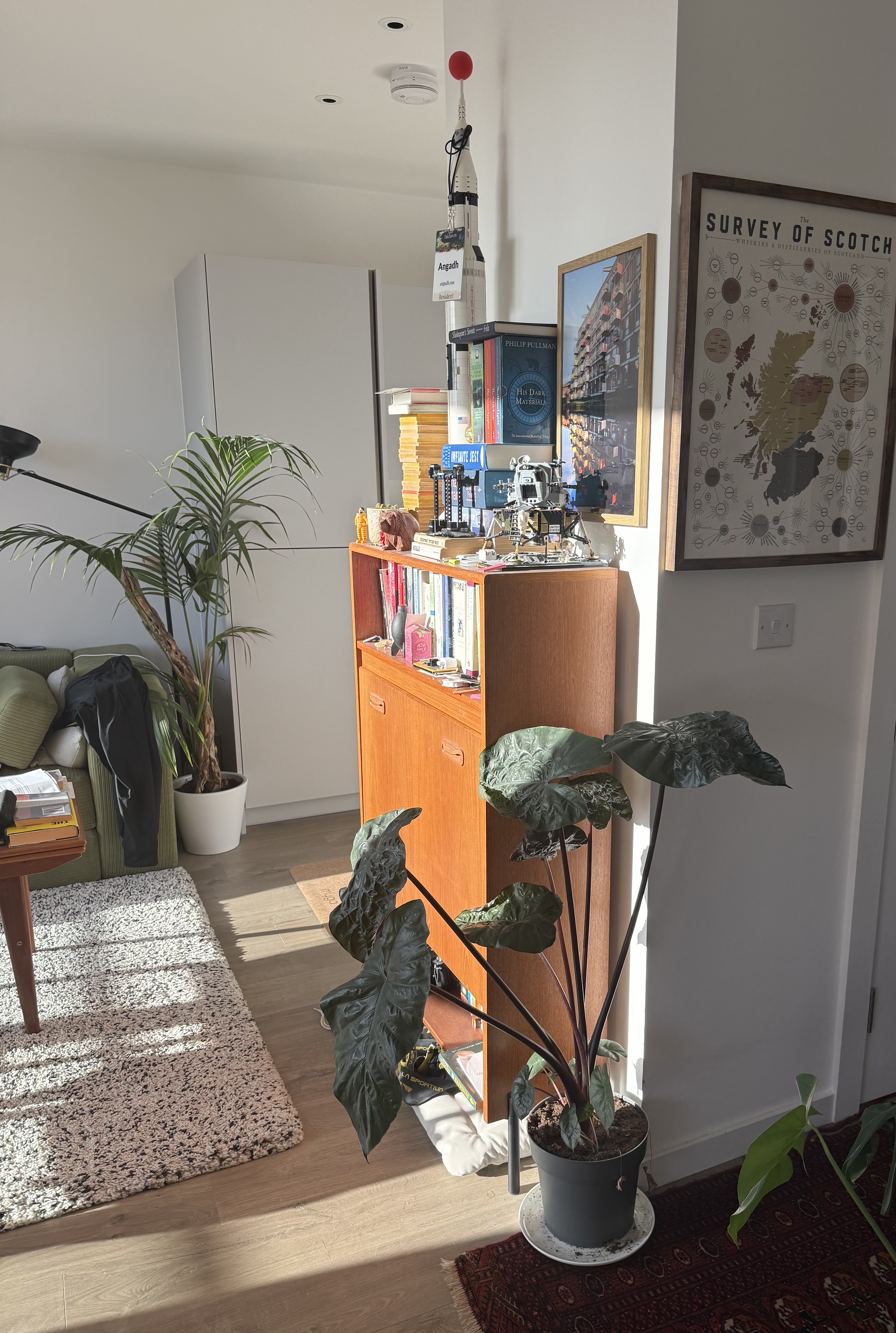
But the same engineering that protects against the winter makes the summer intolerable, even if my plants might beg to differ, as the extended summer sun radiates heat via the windows of my bedroom and balcony, both of which hold a fixed gaze south/southeast-wards into the city.

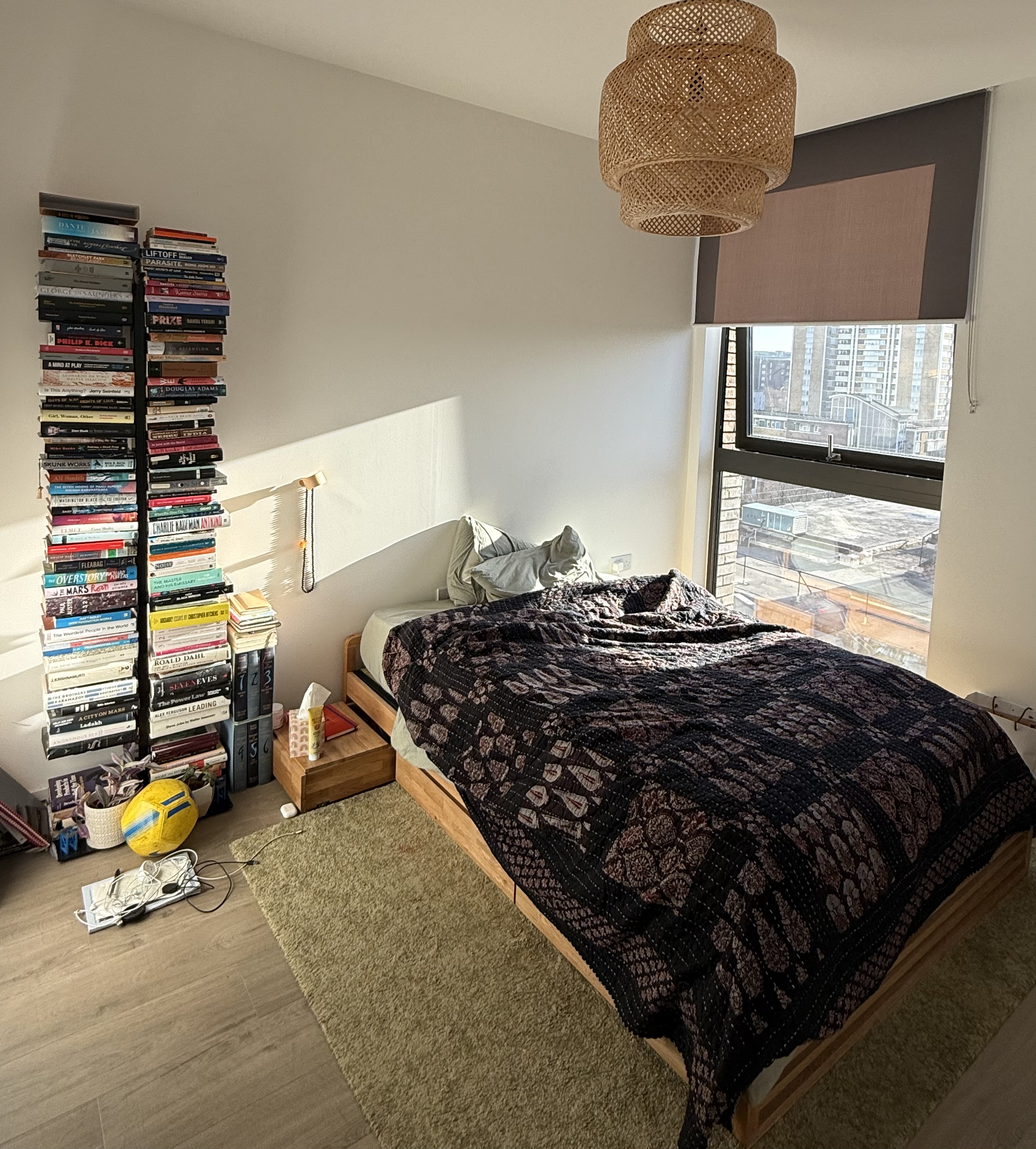
The flat feels like a furnace at summer’s peak and the discomfort is sometimes debilitating; British housing policies have ensured that air conditioning installation is treated as a non-trivial engineering problem. Despite this discomfort, I love living here because the nighttime views of the City are also quite spectacular.
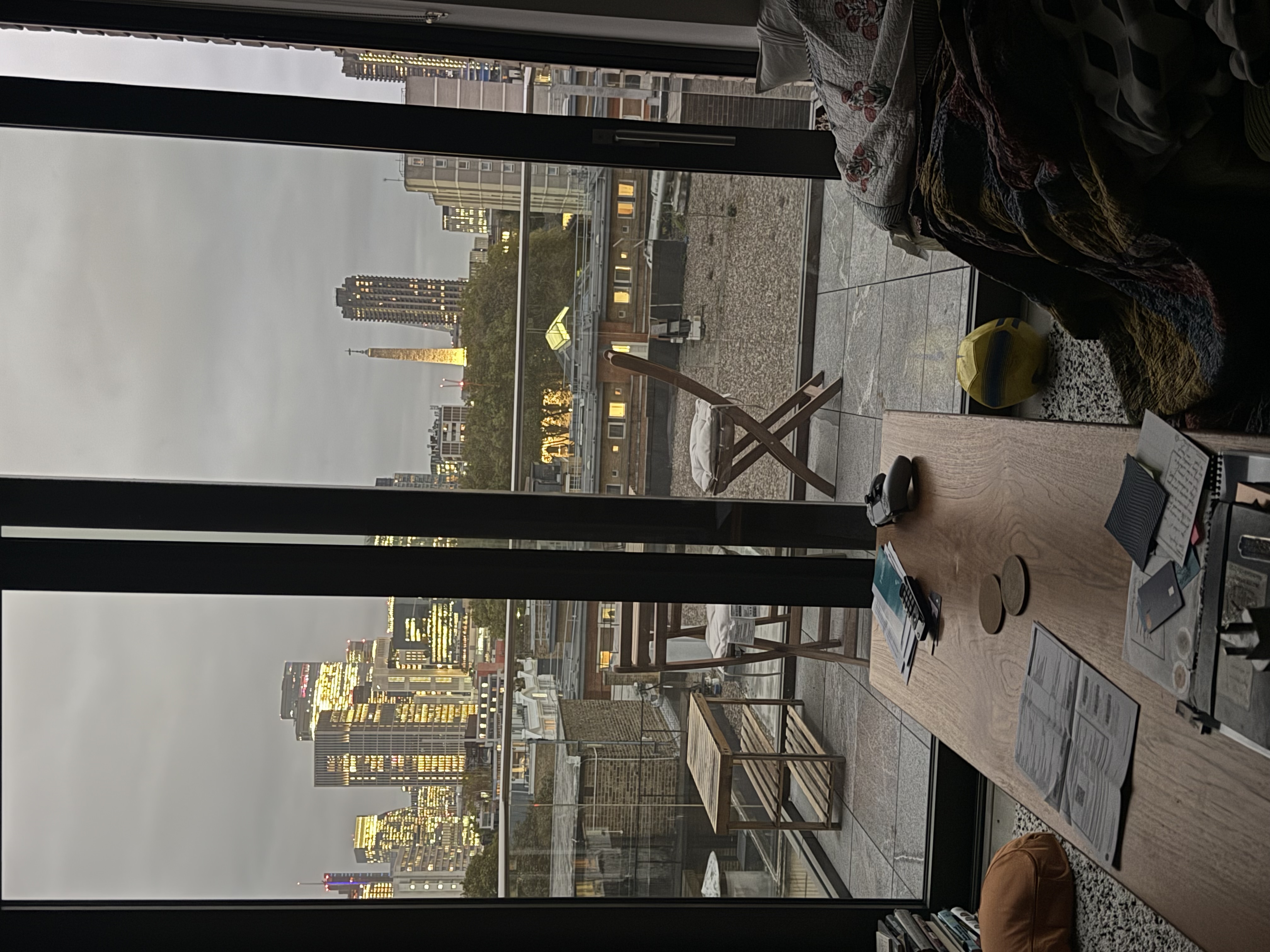
I took for granted the excellent year-round climates in Bangalore and California; balconies in the former and gardens in the latter didn’t feel like luxuries, but both seem so in London. The balcony thus gets put to more than modest use, even in the summer; less so in the rainier parts of the year. But the balcony also offers a portal into London, old and new.
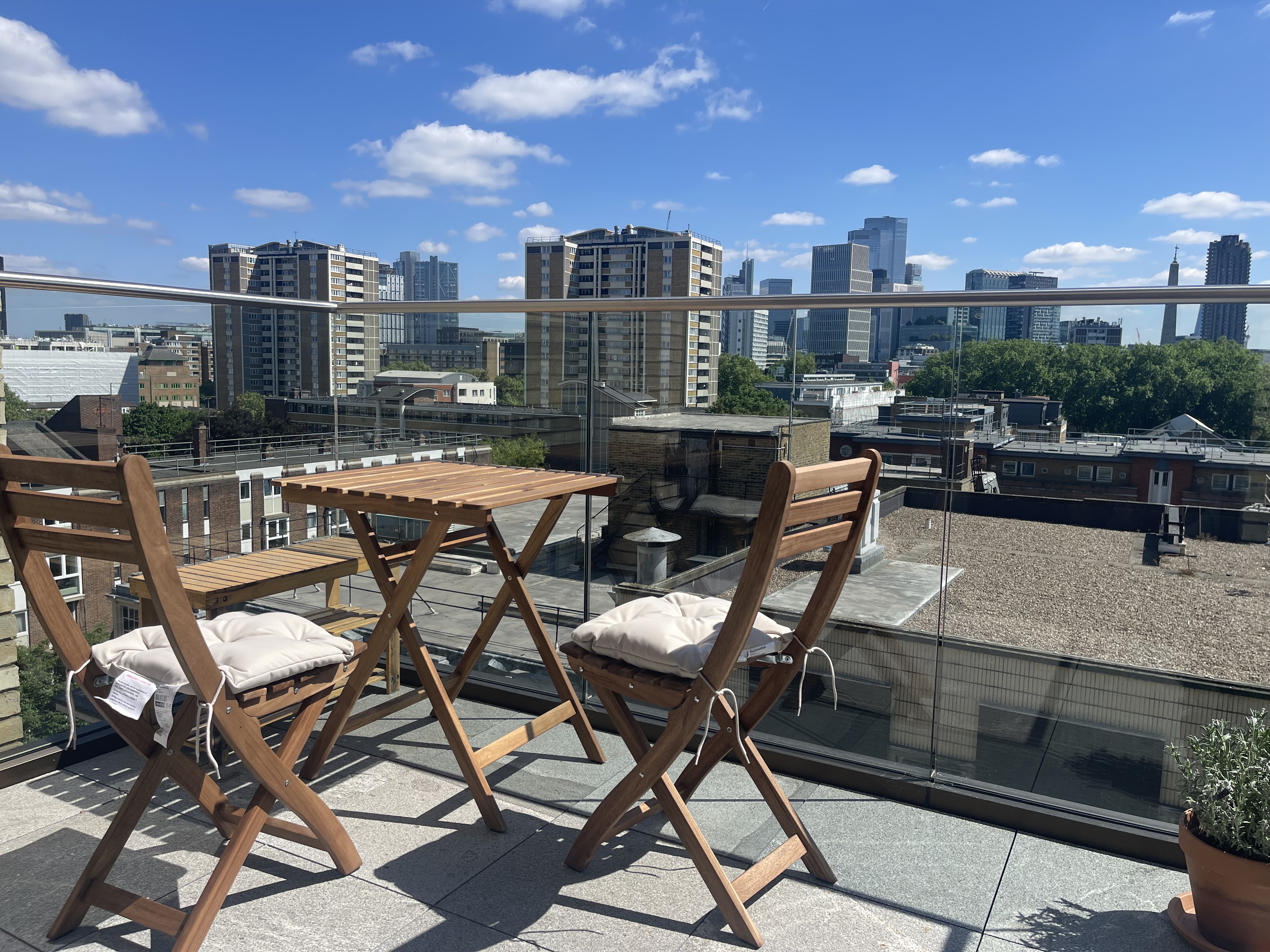
By intent or accident, the residential towers in the foreground tell a story of attempts at ensuring multicultural multiracial socioeconomic integration in this city. The image’s background tells a more contemporary story that may lack that nuance; walking towards this centre for business is also a walk through history that few other cities offer, which makes it nonetheless forceful while retaining some of the quaintness that one associates with the City. There are excellent restaurants and pubs on my doorstep. By foot, St Paul’s Cathedral and the Barbican are roughly twenty minutes away and work is under an hour. The latter journey takes me through Spitalfields Market, where I pick up a Masala Chai and a samosa—all for under £5—on a crisp morning, and Brick Lane.
At forty square metres, the studio is neither too large nor overly cosy—it’s borderline a one-bedroom apartment in universes that exclude the United States. What prevents its classification as a one-bedder is that, instead of a door, a physical wall partitions the sleeping area from the living room.
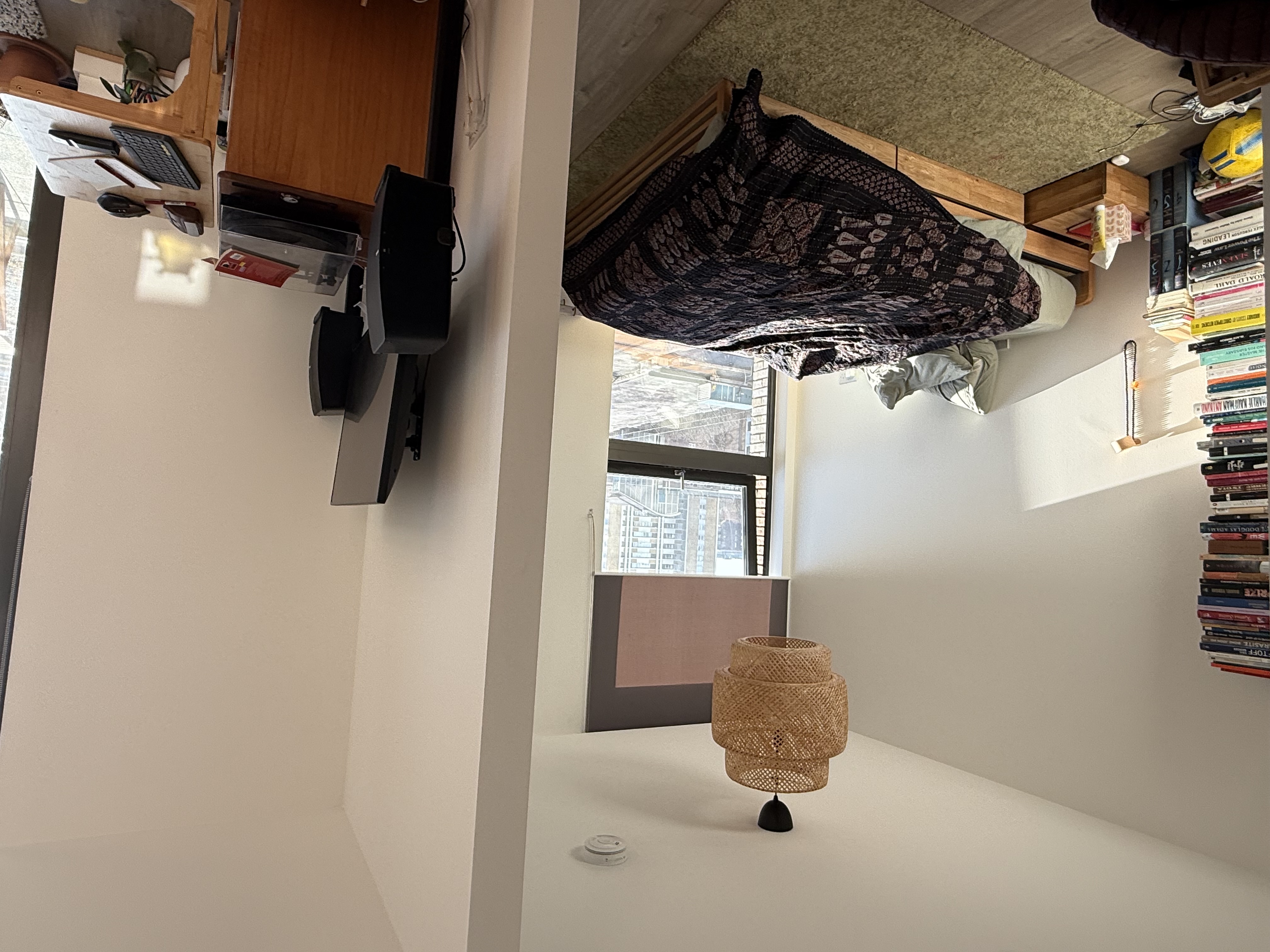
I find this sufficient for myself, but a stretch for more. I tell my mother this and she reminds me that her parents squeezed four kids and her dad’s mother into a matchbox in Mumbai that was half the size of my flat for two decades. There is, I suppose, consolation in that for me, but not for those in the residential towers or the long-term London locals who complain about housing supply; their version of truth fits more adequately into the housing theory of everything, which argues that building more homes in desirable parts of the UK—and the world—will resolve the crisis of high rents and house prices.
Such densified housing is definitely one solution; my flat is part of a bigger complex called 250 City Road approved in 2014 by the then Mayor of London, Boris Johnson, that exposes harsher truths missed in the wisdom of the housing theory of everything. While the flats here deliver on the vision of densified housing, they are anything but affordable despite the mandate that nearly a third of the 995 homes be so.
The flat I have “kind-of” purchased is through what is called a shared ownership scheme. Here, the property developer builds a campus and sells a subset of its flats to a housing association; they then flip the flats to buyers, who can buy a share of the flat at market value provided they meet some income thresholds. The minimum share I needed to buy was 25% (that has dropped to 10% in a recent revision to the scheme) of its market value, and I pay rent to the housing association on the other 75%. In theory, it’s a great solution to a housing crisis in any (expensive) city.
But digging into the details, it’s hard to not feel like one is being somewhat screwed over.
The British government sells title registers for properties sold in the UK, which includes how much the property was last sold for. I purchased this information for a paltry sum recently to learn that the housing association I bought the flat from purchased it from the developer for £307,243 in March of 2024. The valuation when I bought it from them was £482,500That makes my 25% share of the flat worth £120,625; this is the number against which I get a mortgage. in September 2023—6 months before the title register!—and I moved in at the end of March 2024. This inflation makes little sense to me, and the dates make even less sense, but such is the nature of pre-agreed deals, I suppose.
My combined mortgage, rent, and service charge comes to £1,500 monthly; these numbers change annually1. Compared to renting a similar studio nearby—around £2,000—this looks like a good deal. But that apparent savings obscures what happened before I signed: a 57% markup baked into every payment I make. Had I been able to buy at the association’s purchase price, I’d have qualified for a conventional mortgage. The scheme that exists to help people like me first manufactures the unaffordability it then claims to solve.
The standard response is to move somewhere cheaper. But not all careers are portable. Academic positions are scarce and geographically fixed—you don’t choose between London and Leeds, you take what exists. And for immigrants who’ve spent years building social infrastructure in one city, relocation isn’t just inconvenient; it means starting again at middle age—something equally undesirable for long-term locals, not just immigrants. The housing theory of everything assumes frictionless labour markets. Real lives have friction.
Even worse is that the inflation disqualifies other low-income earners who are also desperate for homes by pricing them out; as I learned through the house purchasing process from the housing association and lenders, few people are able to meet the income thresholds despite being interested in these flats. One might think—as I did, initially—that the potential buyer has misunderstood the terms (which may be somewhat true) but the inflated price does lead one to contemplate how rigged the game is.
Before here, I lived in a six-person houseshare near Brixton—this is the reality for a lot of young professional Britons, some of whom wish to start families. Houseshares are unfit for that. Shared ownership offers a theoretical path: larger two- and three-bedroom flats exist under the scheme in Zones 2, 3, and beyond, better suited to families than a studio in Zone 1. But if the same inflation applies—57% markups baked into valuations—those flats will price out the very households they’re meant to serve; this is especially the case if we factor in that salary thresholds to qualify for shared ownership are unchanged against the size of the flat. The scheme doesn’t solve the problem; it replicates it at every scale. If this remains the model, these cities will not stay places teeming with culture and economic opportunity. We see the city as a forest but forget the people are its trees.
Afterword
My home, like that of others fortunate enough to even have one, sits not in isolation but within a village or a town or, as is my case, the Western equivalent of a megacity: London. Here, the flat serves not just as nest but also as office, alternating between the two to settle for the flat-as-an-office moniker, not the flat-as-a-family-home. It’s not just the flat that is my home, but the city of London. Contented as I am with this state of affairs, I see how this is limiting for others who may want more, especially those born and raised here.
This does not bode well for the landscape of the Western megacity flats that wish to be more. Some of them will wish to be more organic in function; to grow. They desire harmonious expansion with its inhabitants, to manifest a culture, to become a host to friends, family, and future generations. To them, the flat-as-an-office leads to nothing.
-
The rents in shared ownership schemes increase either by the Retail Prices Index (RPI) plus up to 0.5%, or the Consumer Prices Index plus 1%. I think mine is the former. ↩