A Vacuum of the Imagination
Yet it is clear that in many cases there is indeed no good reason why an invention was made at a particular point in time and not centuries earlier. It is tempting to argue that lack of perceived need or demand was responsible, but it is also possible that a particular innovation simply did not occur to anyone before.
The Lever of Riches, Joel Mokyr
I have long suspected space rockets could have been invented earlier than Goddard’s 1926 flight — but why did we wait until then to see them? This essay sits within a family of other explorations into understanding why inventions appear when they do. The general consensus is that “most useful technologies tend to be invented quite quickly once they are possible”, but this feels untrue for rockets.
For the purpose of this writeup, I’ll define a space rocket as one based on its technical intention, not flight success; Goddard’s was to reach the Moon, stated in his 1919 paper “A Method of Reaching Extreme Altitudes”. That intention, not success, is a necessary and sufficient condition to define a space rocket. It should be acceptable even today: more upstart space-rocket companies are yet to successfully achieve orbit, but their intent is what defines them. Goddard’s first rocket flew to an altitude of 12.5 metres and the highest altitude he achieved was roughly 2.7 km; this provides some justification for also considering amateur rocketry in this essay. Hobbyist rocketry today is a signal of intent from students wanting to work in the space industry, and a somewhat serious hobby for others generally interested in space exploration. So, I also lean on this group in developing this essay to answer when rockets could first have appeared and why they didn’t happen earlier.
It is worth noting that liquid space rockets emerging before solid ones is historically unusual; a harder, higher-performing technology doesn’t often mature before a simpler one. But this invention sequence might actually have resulted in space progress happening more slowly than it should have. Here, I make the case that the critical innovation of both rockets — their propellant — could have happened several centuries earlier!
It is also useful to have some preliminary knowledge of rocket propellants; propellants are principally a mixture of a fuel and its oxidiser. Liquid propellants that commonly power space rockets control the mixing of the two in the combustion chamber by storing them in separate tanks. When they enter the combustion chamber, they are either ignited using an external source or self-ignite on contact (a phenomenon called hypergolicity). SpaceX’s Falcon rockets have Merlin Engines that use liquid oxygen (LOX) to oxidise rocket-grade kerosene whereas Starship’s first stage (i.e., Super Heavy) has 33 Raptor engines burning liquid methane and LOX (also called methalox). Methalox behaves like a hypergolic pair but isn’t: Raptor pre-burns both fuel and oxidiser before they are allowed to mix in the main chamber as gases hot enough to ignite on mixing — thermal autoignition rather than the chemical self-ignition of true hypergols. Falcon’s Merlin engines inject a pyrophoric (triethylaluminium-triethylborane) to trigger combustion. Solid propellants are commonly used in missiles or as boosters to the main liquid-fuelled launch vehicle. Common solid rocket fuels are typically produced by casting: the fuel is melted or mixed as a fluid with oxidiser crystals suspended in it, then poured into the casing, where it solidifies as a single bonded grain.
So when was a space rocket possible?
A recent Claude-driven analysis concluded that Goddard’s liquid-fuelled rocket appears shortly after it was technically possible1 to produce LOX at an industrial scale. That Sputnik followed only 30 years later suggests spaceflight hinged on the LOX production constraint being lifted. But this doesn’t really answer “what other liquid oxidisers existed or could have been invented earlier?” The aforementioned list of 190 inventions also doesn’t contain purely solid-fuelled orbital-class vehicles that were eventually invented; this begs a similar analysis into solid propellant rockets: were they also bottlenecked? If neither of these turn out to be specific bottlenecks, then what other factors might have prevented the space rocket from taking flight earlier?
How much earlier could liquid propellants have been invented?
John D. Clark’s Ignition, a fun read on the history of liquid propellants, points to liquefaction — specifically, the ability to convert oxygen and hydrogen gas into liquid oxidiser and fuel respectively — being pivotal to enabling liquid-fuelled rockets. From his eponymous equation, Tsiolkovsky concluded that this liquid fuel-oxidiser combination is vastly superior to gunpowder, a millennium-old solid propellant for artillery — and the ideal propellant to enable space travel.
The maturation of liquid-propellant space rockets happened before solid propellants due to the rapid strides in refrigeration technologies by engineers working on regenerative gas liquefaction2, like William Hampson and Carl von Linde, and liquefaction-obsessed scientists a century before them. After developing his industrial ammonia vapour-compression refrigerators3, Linde successfully liquefied air in industrial quantities at the same time as Hampson in 1895. Fractional distillation could yield industrial-scale oxygenLiquid oxygen had known industrial uses in metal cutting and welding, but nitrogen only found use in the fertiliser industry much later.. Meanwhile, Dewar had reached liquid hydrogen by 1898 — Tsiolkovsky’s proposed fuel to be oxidised by LOX per his landmark 1903 paper on rocket-powered space exploration. Goddard would reach a similar conclusion about needing a liquid oxidiser independently soon after.
But there were other liquid oxidiser-fuel pairs that one could have worked with to invent a liquid-propelled rocket before LOX was derived. Nitric acid being hypergolic with turpentine is attributed to Frederick Slare in the late 17th century, but red fuming nitric acid (RFNA) only appears in various missiles (e.g., German Wasserfall SAM, Scud missiles) from the Second World War. The French space rocket Diamant’s first stage then also used this combination.
Turpentine is believed to have been available since antiquity and is made by distilling the resin harvested from pine trees. Also made by distillation, a crude form of nitric acid was available since the 13th century, when alchemists first distilled it from saltpetre (potassium nitrate) and vitriol (sulfuric acid). A storable — in glass, not metals — purer liquid form was discovered much later by Johann Rudolf Glauber in 1648. It is this concentrated form that Slare’s ignition would have needed — the crude medieval acid would not reliably ignite with turpentine — which pins a storable hypergolic pair to roughly 1650. This, nonetheless, suggests that a hypergolic liquid propellant could have existed anywhere between three and six centuries before Tsiolkovsky; more interestingly, it could have existed before the Industrial Revolution (more on this later).
Now, if one revisits the aforementioned Claude-analysis, the binding constraint is no longer a storable liquid oxidiser; it is other systems such as cryogenic valves, gaskets, insulated piping, all of which were a consequence of liquefaction. Mature rockets would also need convergent–divergent nozzles, high-pressure metal tanks, seamless steel tubing, and pressure-fed propellant feed systems which would need to be developed. This would clearly change the technological development pathway of the rocket. This presents an interesting rabbit hole to go down, but is not the intent of this post4. Instead, I will consider when a solid space rocket might have actually been technically feasible.
How much earlier could castable solid propellants have been invented?
Historically, solid propellant development is primarily linked to its defence applications for missiles, which only later were used in space rockets. Black powder (or gunpowder) was first used in fire arrows in ninth-century Imperial China; Needham doesn’t consider these rockets and identifies missiles as being rocket-like from the twelfth century. However, innovation in solid fuels stalled for a millennium; Paul Vieille’s 19th century invention of smokeless gunpowder aided progress by routing it through guns. This largely explains why Tsiolkovsky’s analysis compares liquefied gases (LOX, LH₂) to gunpowder. It was only in the 1960s when examples of orbital launch vehicles using only solid fuel stages emerge (Scout and Lambda 4S). These use ammonium perchlorate-based composites, whose legacy traces to Cold War-era missiles like Polaris and MinutemanTitan-III and the Space Shuttle also made use of APCP..
Perchlorates in the 17th century
The property of solid propellants being storeable at room temperatures makes them appealing for military uses; ammonium perchlorate composite propellant (APCP)-fuelled missiles could be pre-fuelled and stowed away, which allowed a rapid response to incoming threats. Liquefied propellants (LOX, LH₂) are less well behavedThey continuously boil off at room temperatures so require cryogenic cooling systems (below −183 °C for LOX, −253 °C for LH₂). which makes it impossible to keep missiles pre-loaded. This also makes solid rockets much simpler; they don’t require pumps or plumbing so consequently perform better on metrics such as thrust-to-weight and cost. Their main downside is they lift less mass-to-orbit on account of a lower specific impulseA parameter quantifying momentum imparted to a rocket per unit mass of propellant burned.; this is not ideal for large space missions, but is less of a blocker for smaller or suborbital missions launched on sounding rockets.
APCP was developed by Thiokol/Aerojet in the 1950s by improving on Parsons’ insight that an oxidiser-in-fuel-matrix mixture burns steadily as a bonded grain instead of detonating like a bomb. His GALCIT-53 propellant recipe (potassium perchlorate oxidiser with asphalt fuel) was the first successfully demonstrated castable composite propellant in 1942. APCP improves its specific impulse by using powdered aluminium as a fuel, bound in a polymer matrix with polyurethane or polybutadiene-type binders to ammonium perchlorate oxidiser.
So, how much earlier could perchlorate-style composite propellants have been invented? The answer depends on how early perchlorates could have been synthesised.
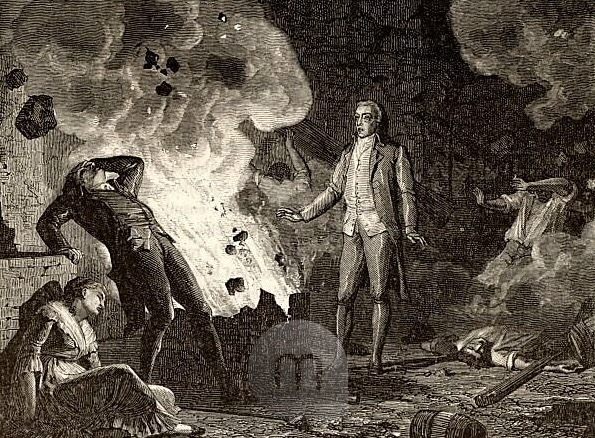
Claude Louis Berthollet — made chlorates in 1786; his 1788 chlorate gunpowder killed at the Essonne mill, tainting chlorine oxidisers for 150 years. Public domain.
Based on material resources, the optimistic answer points to the mid-1600s, but the required chemical concepts suggest somewhere between 1790 and 1820. The full material chain for perchlorates only requires chlorine to be discovered5; by 1658, Glauber had discovered hydrochloric acid (from which chlorates and then perchlorates could be synthesized). Claude Louis Berthollet eventually made chlorates in 1786 by passing chlorine gas (synthesised in 1774) over hot potash. Potassium chlorate’s explosive power allowed him to see it as an alternative oxidiser to saltpetre in gunpowder. Berthollet then worked to scale production but accidentally blew up the Essonne gunpowder factory, killing people inside it. This and potentially other chlorate accidents likely blocked the path to the comparatively safer perchlorates as the whole class was likely mentally filed as explodes-when-you-look-at-it.
So, there are reasons to think that engineering science/math were not binding constraints on discovering better fuels than gunpowder for missiles; they could have been discovered from iterating on solid fuels as Berthollet was doing had the risk appetite been there.
In Britain, the Congreve and Hale rockets of the 1800s continue to use gunpowder, much like their inspiration6 — the Mysorean rocket — but the emergence of smokeless powder and its double-base descendants (ballistite, cordite) potentially drove up demand for rifles at the expense of rockets. In fact, when British chemistry hunted for an alternative to black powder, nitrocellulose (1846) emerged and absorbed the institutional resources — the incentive gradient pointed at nitro-chemistry right as rifled artillery was killing off military rockets anyway. These double-base propellants became the first modern solid rocket propellants by WWII (e.g., Katyusha rocket launcher, bazooka), before castable composites displaced them. This reversal is worth noting: Van Riper says early missile technology matured faster than guns, but nitrochemistry for guns became the counterintuitive engine for progress on propellants by the mid- to late-1800s.
Also, APCP’s production at an industrial scale required two other advances: electrolysis for ammonium perchlorate production, which only became possible around 1900; and the Hall–Héroult process for producing aluminium powder economically in 1886. It is also worth considering that, in 1816, Count Friedrich von Stadion eventually synthesised potassium perchlorate from potassium chlorate, and that the very same perchlorate is the oxidiser Parsons used over a century later!7 So even a GALCIT-53-style of propellant could have been developed far earlier despite some of the constraints on APCP.
Rocket Candy in 10th-13th Centuries
Amateur rocketry shows that a precursor to APCP, called “rocket candy”, could have existed much earlier as it is a sugar-based alternative. Rocket candy uses saltpetre as an oxidiser for its fuel — sucrose8. The original 1943 propellant was simply the two powders damp-pressed into shape without cooking; the familiar melt-and-cast method, where sugar is melted and poured into moulds, only followed around 1950. Both techniques were possible in medieval workshops: melt-casting sugar is believed to have been an established confectionery craft since about the 10th century CE. Cast sugar specifically is attested by the eleventh century, when Mintz describes an Egyptian caliph’s feast displaying 157 sugar figures and seven table-sized sugar palaces — a festival sugar culture Sato traces through al-Maqrizi’s accounts of Fatimid Cairo.
The origins of sugar trace to third century BCE India where cane juice was boiled into raw granular sugar. Indian sugar refining techniques reached China by the mid-7th century; Emperor Taizong of Tang sent a mission for it. Alongside using gunpowder rockets from at least the ninth century CE onwards, China also had a well developed saltpetre-purification, and a real sugar-refining industry. The Tang and the Song dynasties that followed them are both believed to have used black powder rockets. Contrasting black powder’s charcoal fuelSulfur is added to lower the ignition temperature to help the reaction propagate., also oxidised by saltpetre, further suggests that chemistry and materials weren’t the bottleneck. These rocket powders were demonstrably tuned per Van Riper, who notes they were deliberately blended slowly — less saltpetre, more charcoal — to deflagrate steadily rather than burn explosively. This loose powder was also dampened then dried in place into a solid cake; experimenting with another fuel seems like a missed opportunity in hindsight.
Sugar production likely also spread to Persia in the Sasanian period (224 to 651 AD), with full-scale refineries for industrialised sugar production believed to appear in the 8th–9th centuries in Egypt, Syria, and Mesopotamia; temperatures for melt-casting are also similar to those needed for caramelisation, which existed in thirteenth century Syria. Hasan al-Rammah’s treatise on the use of gunpowder recipes in the famous “self-moving torpedo” and rockets is testament to sugar-casting capabilities and rocket-making craft likely coexisting in these parts since the mid-1200s CE.
Rocket candy’s specific impulse (~120–130 s) is roughly twice that of black powder (~60–80 s)But less so than APCP (~240–260 s) and not too far from Parsons’ GALCIT-53 composite (~180 s).. The incentive to build ever more powerful missiles is constant through time — warfare assures that — from the Chinese fire arrows to the later Mysorean rockets, but the idea to use rocket candy was missed. Neither chemistry nor raw materials appear as bottlenecks based on what we can tell, so other explanations for why rocket candy doesn’t replace gunpowder must be considered.
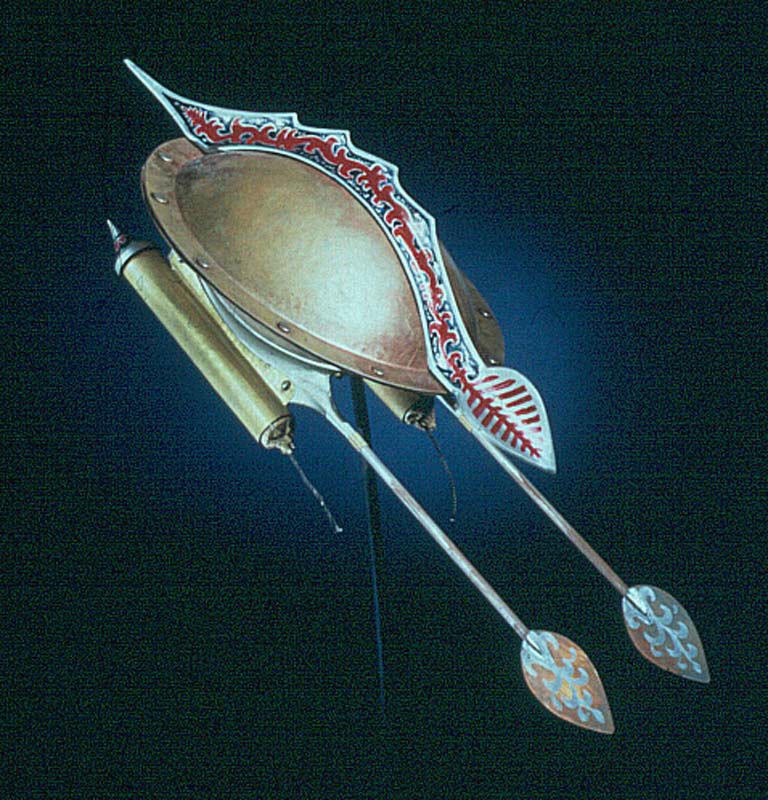
Rocket Torpedo, Hasan al-Rammah, ca. 1280 CE.
One is the practical matter that candy grains are hygroscopic, making them a liability in the humid climes of India and coastal China, where damp black powder could simply be re-dried and re-milled, though sealed storage for protecting gunpowder might have made this a nuisance rather than a blocker. Such moisture would not have been an issue in arid parts of the Arabic world. Another potential explanation might lie in the Taoist text Zhenyuan Miaodao Yaolüe, which describes a saltpetre–sulfur-honey mixture burning down houses. This shows the explosive chemistry with sugars; perhaps rocket candy’s potential development was blocked by what one might label as low risk appetite, as happened much later with Berthollet’s chlorates. One caveat is that candy’s edge over gunpowder might have been hard to spot in nozzle-less paper or bamboo tubes. Tight iron casings might have revealed it, but appear only with the Mysoreans. However, Song China, which had rockets, had also cast iron bomb shells by the early 1200s, and Mysore’s casings were hammered sheet iron well within Chinese or Syrian smithing.
It’s worth noting that sugar’s costs in India, China, or Syria do not factor as reasonable counters to the development of rocket candy given their supposedly mature production techniques which made sugar a commodity, not a luxury. However, costs might explain why we don’t see rocket candy emerge in Europe after; sugar sat on apothecary shelves next to spices, and it appears in royal household accounts in pounds per year. A skilled craftsman earned 4–6 pence a day so a pound of sugar cost several days’ skilled wages whereas charcoal was not prohibitive (price tables, Hodges’ list); sugar was more expensive than charcoal in 14th–15th century England, retailing for 1–2 shillings per pound whereas charcoal was a bulk commodity sold by the sack for pennies.
So, if the main binding technology — propellant — could have existed from the mid-1600s for liquids, and as much as a millennium ago for solids, why was a space rocket attempted only in the 20th century and not earlier?
A Vacuum of the Imagination

The answer that I have settled on is best summarised as a lack of imagination. Imagination in the creative arts and the hard sciences is unusual and essential to progress; this is especially true here.
Consider Goddard’s formative interest, which traces to his reading H. G. Wells, and Tsiolkovsky’s purported influences, which included Jules Verne and Nikolai Fedorovitch Fedorov, the founding father of a Russian-flavoured transhumanist movement called Russian cosmismRead more here.. The influence of sci-fi writers and philosophers on space rocket scientists supports the conclusion that a wilder imagination precedes technical creativity.
But inspiration is not always traceable. William Leitch, a Scottish astronomer, predates Tsiolkovsky by four decades in presenting the scientific basis for space exploration using a rocket9. His 1861 analysis could have been inspired by Francis Godwin’s novel about a man who flies to the Moon on birds, or Cyrano de Bergerac’s parody of Godwin, taking it more seriously than Cyrano himself10. Leitch’s idea was clearly ahead of its moment, but he might have received the attention and adulation of Wells and Verne had he written a fictional piece exploring space exploration’s impacts on society that complemented his technical work.
It is worth noticing what the great astronomers were not thinking about in seriousness. Tycho Brahe spent decades observing planets without, as far as we know, ever conceiving of them as destinations; the question of how to travel cannot arise before someone imagines going. Newton’s cannonball thought experiment is embryonic orbital mechanics11 but is not framed as a means of off-planet transport; Leitch finds this answer over a century later by framing the use of a rocket in space exploration. Technical experts do not always have oracular gifts, which shows discovering principles does not make them useful; that still needs the freedom to explore an idea devoid of rules for a while. In fact, Kepler is the outlier astronomer who proves this point. His Somnium uses fiction as an engine to imagine life off-planet, achieved via a daemonic vehicle. Even though it is unrealistic, it seeds a target.
That imagination is a difficult capacity to build is also evident throughout history. Hero’s aeolipile is considered amongst the earlier prototypes of the steam engine, steam turbines, and potentially even the reaction engine. That moment could have been the hinge point nearly 2000 years ago for a lot of technological development, but that doesn’t really happen until the Industrial Revolution. The first envisioned uses for a space rocket (Tsiolkovsky and Leitch) were for space colonies, not about atmospheric measurements (Goddard) and Earth observation satellites (Hermann Oberth).
Anton Howes says innovation is not innate to humans. Humans don’t possess an inherent gift for technological prognostication as, historically, technology development was driven by mundane concerns. Here, the example is rocket-like missiles developed as a defence tactic many centuries before the Industrial Revolution. Low institutional risk-appetite kills promising paths to better fuels repeatedly (two instances presented above with honey and chlorates) and the status quo of gunpowder remains the norm for nearly a thousand years.
But these blockers — risk appetite, cost, and the military’s grip on rocketry — are symptoms of the missing goal rather than rival causes: they kill the means only when the goal is mundane. Apollo teaches us that a Moon-shaped goal absorbs risk and cost, but in its absence wars supply that goal — twice abandoned perchlorate chemistry became APCP within a decade during the World War and then the Cold War. This is also why I define a space rocket by its intention, which cannot appear in the absence of imagination.
Can incentives solve the problem of humans not being imaginative? Can a curiosity-driven researcher be incentivised to imagine uses? Abstract thinking to convert missile technology into a space exploration technology seems to appear devoid of clear incentives; progress happened because some individuals eventually imagined what most others couldn’t.
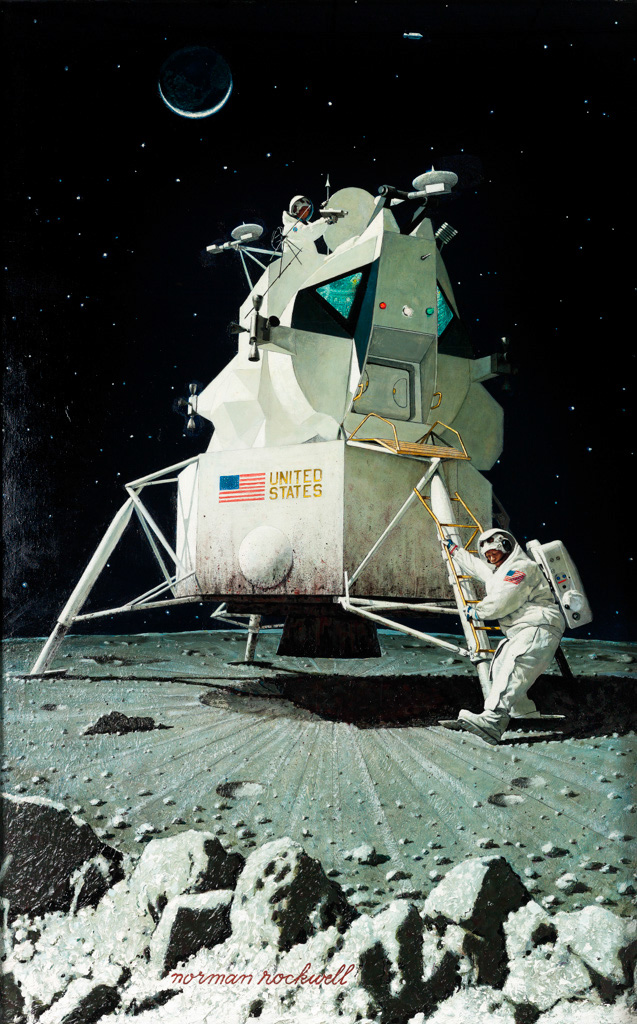
Norman Rockwell, Man’s First Step on the Moon, 1967 (Look) — painted two years before the fact.
What the record shows is an inversion of the usual pattern: for most technologies, imagination waits on capability; for the space rocket, capability sat available for centuries while its use — reaching worlds we could only see from afar — went unimagined outside stories and satire. So while Tabarrok, reading Potter’s analysis, is reassured that most useful technologies are invented quickly once they become possible, possible is doing heavy lifting in that sentence: it is vision that drags an idea from the future into the present.
References
-
A New Look at Heron’s “Steam Engine” by Paul Keyser
-
Rockets and Missiles: The Life Story of a Technology By A. Bowdoin Van Riper
-
Claude labels its confidence about this date as medium; another 156 of 190 inventions since the 1800s also have this confidence while only 24 have a high confidence. So make of this what you will. ↩
-
This is called regenerative cooling in refrigeration — a distinct concept from the same terminology in rocketry. ↩
-
Such a fridge compresses and condenses ammonia, then lets it evaporate to absorb heat. Breweries wanting perennial cold fermentation of lagers were Linde’s customers. ↩
-
I encourage someone else to consider this, but my suspicion is that we either need to wait for refrigeration and turbine engineers to make the necessary advances, but it is more interesting to consider what happens if rocketry shows sufficient promise. Do we end up tracing a totally different path that bypasses the development of steam engines? ↩
-
The other ingredients: sulfuric acid from distilling vitriol has medieval origins; manganese dioxide was used for glassmaking since antiquity; and saltpetre is ancient. ↩
-
The UK’s revisionist history says Tipoo Sultan was fascinated by British rocketry, which contradicts Van Riper’s counterpoint (on page 15) that Tipoo inspired the British: “After the capture of Seringapatam and the death of Tippoo Sahib, the British shipped hundreds of rockets home to the Royal Arsenal as spoils of war. The point of the shipment was less to equip British troops with Indian rockets than to “reverse engineer” them: take them apart, study how they were made, and learn how to build rockets that were as good or better.” ↩
-
A science for deflagration versus detonation emerges between Berthelot and Vieille so it’s possible that one couldn’t have reasoned about how to make the mixture burn steadily rather than detonate until Parsons’ work on potassium perchlorate. So it is possible that perchlorates, while possible much earlier, couldn’t have been technically developed before Parsons. ↩
-
Modern rocket candy is made from sorbitol, a sugar alcohol made in the 20th century for use as a diabetic sweetener, because it has desirable properties like lower melt temperature than sucrose; doesn’t caramelise; and its grain is less brittle. ↩
-
The only earlier mathematical analysis on rockets is William Moore’s “A Treatise on the Motion of Rockets”, which was performed for Woolwich Arsenal’s missile development. ↩
-
Cyrano’s protagonist reaches space strapped to a rocket that drops away after lifting him free of the Earth — widely regarded as the first use of a rocket in European interplanetary fiction, including by Arthur C. Clarke. ↩
-
Newton’s thought experiment was written around the 1680s, published posthumously in 1728. He imagined firing a cannonball from a mountaintop fast enough that it falls around the Earth instead of back onto it. This is the conceptual seed of orbital mechanics and the artificial satellite, but does not explain rocket launch mechanics itself. ↩